.avif)
[Updated, September 2026]
Key Takeaways:
Under the Simplified Credit Treatment (SCT) scheme, SP Group customers earn around 25 cents/kWh for surplus solar exported to the grid at Q3 2026 tariff rates (the highest export credit on record). ECIS pays the wholesale USEP instead, which averaged S$193.59/MWh in Q2 2026 and moves every half hour. For most landed homeowners on SP Group, SCT still pays more, and pays predictably.
Singapore's regulated electricity tariff hit 34.78 cents/kWh including GST on 1 July 2026, the highest in the country's history. That cuts both ways if you own solar. Grid electricity costs more now, but the credit you earn for exporting surplus solar rises with it.
Generally, there are three main ways to sell excess solar back to the grid: the Simplified Credit Treatment (SCT) scheme, which offers predictable credits based on quarterly SP Group rates and suits most residential users; the Enhanced Central Intermediary Scheme (ECIS), available to those signed on to Open Electricity Market (OEM) retailers, where credits are based on the fluctuating wholesale Uniform Singapore Energy Price (USEP); and the Market Participant (MP) scheme, for larger commercial solar producers who register directly with the Energy Market Company to sell electricity at market prices.
This guide covers the SCT and ECIS schemes, breaking down how they impact your electricity saving efforts and how to make the best financial choices for your home.
How Solar Energy Reduces Electricity Bills
Solar panels produce electricity during the day by capturing sunlight, which powers your home and cuts down on your reliance on the grid This means less grid consumption during daytime hours. Curious what a system actually costs to install and how long it takes to pay back? Our solar panel installation cost guide breaks that down separately.
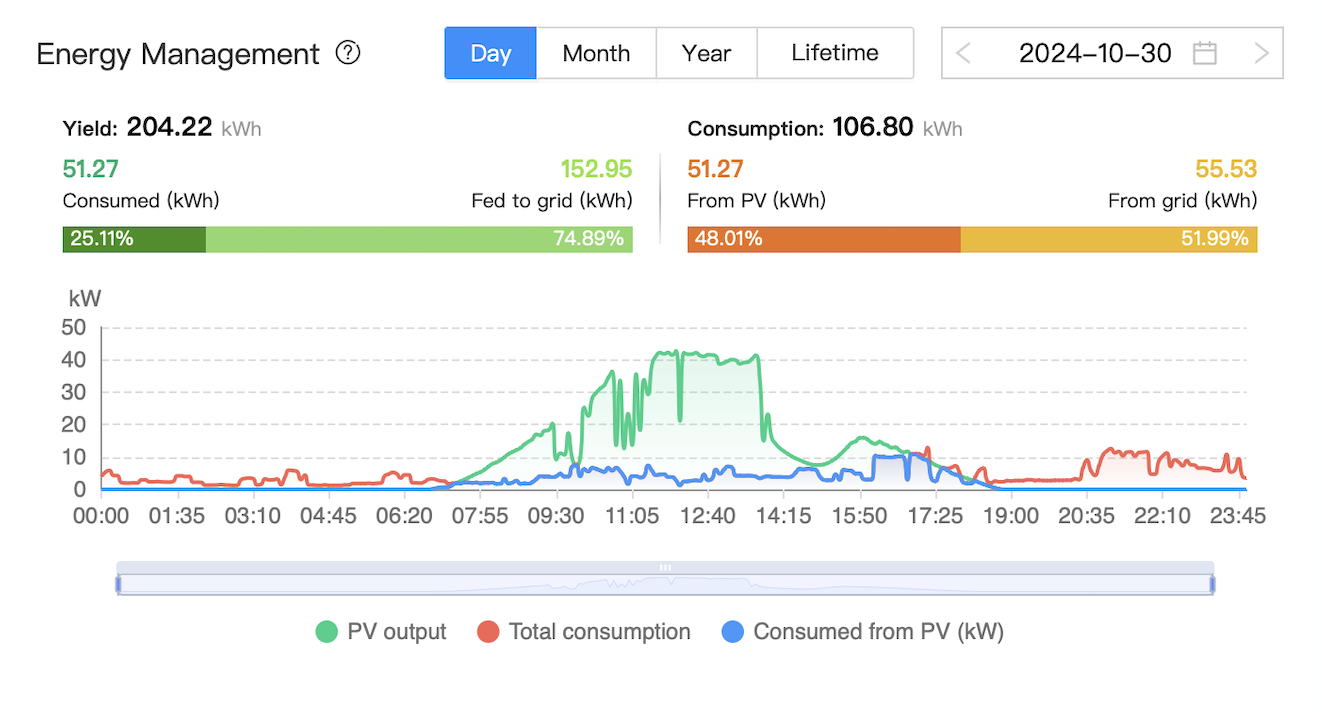
As shown in this example chart from the inverter app, solar generation (green line) peaks around midday. The blue line indicates how much of this solar energy is directly used by your household. During the day, most of your home's energy needs are met by solar. The red line shows how much you still draw from the grid. Any extra solar energy not consumed is sent back to the grid, earning you credits on your electricity bill and further lowering your costs.
In this example, your household used a total of 106.80 kWh of electricity. Of this, 51.27 kWh was covered by solar, reducing the electricity needed from the grid. The remaining 55.53 kWh was drawn from the grid, mainly at night when your solar panels weren't producing. Meanwhile, your solar system generated 204.22 kWh for the day, with 152.95 kWh as surplus energy, which was sent back to the grid, earning credits.
You can track this with your solar inverter app to monitor energy production and consumption in real time. The app shows daily solar generation and how much energy is used versus what is exported. This insight helps you understand your energy use patterns and spot where you're saving the most.
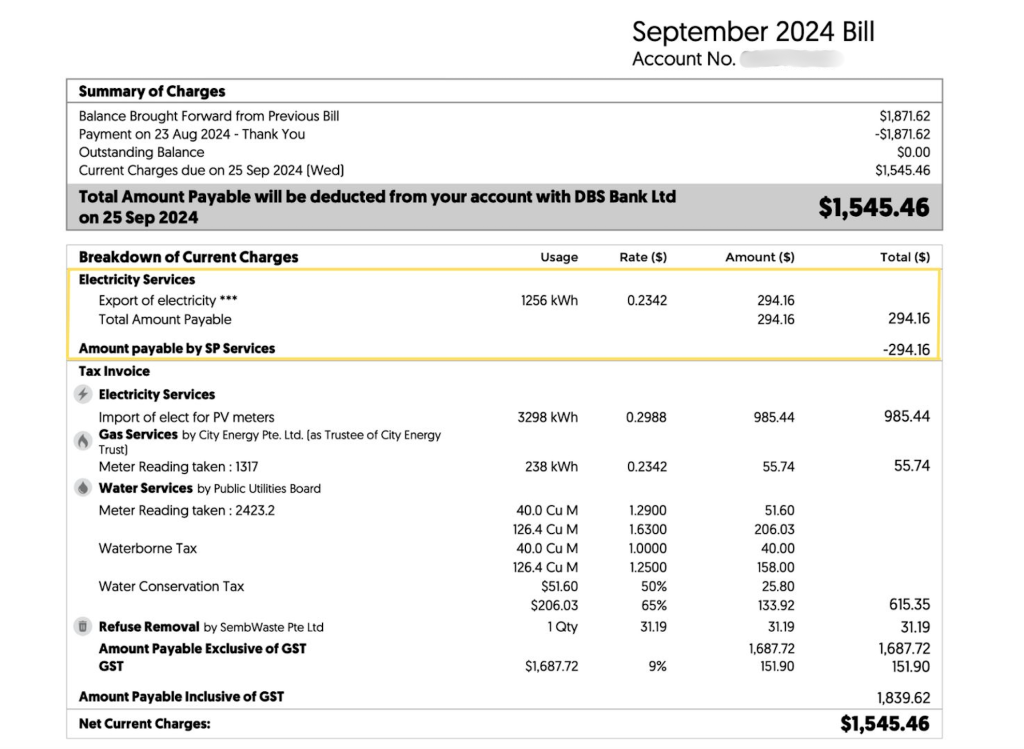
On your SP bill, you can find the "Export of electricity" section showing credits earned by sending surplus energy to the grid. On this September 2024 bill, 1,256 kWh exported at 23.42 cents/kWh earned a credit of S$294.16, which offsets the total owed for grid electricity. At Q3 2026 rates the same export would credit around S$320.
Solar Sell-Back Options in Singapore
Which scheme you qualify for depends on who you buy electricity from, not what kind of property you own. The Energy Market Authority splits solar consumers by contestability: Non-Contestable Consumers buy from SP Group and use SCT, while Contestable Consumers buy from an OEM retailer and use ECIS.
Simplified Credit Treatment (SCT): Designed for Non-Contestable Consumers, meaning you get your electricity from SP Group rather than an OEM retailer. It offers a stable credit based on the quarterly tariff rate minus grid charges, which works out to roughly 80% of the tariff. SCT applies to solar systems below 1 MWac. In Q3 2026, with the SP Group tariff at 31.91 cents/kWh before GST and a grid charge of around 6 cents, the SCT credit lands at about 25 cents/kWh. That is the highest export rate the scheme has ever paid, and it followed July's 17% tariff rise directly. If you're weighing this against a longer-term fixed-rate arrangement rather than a quarterly-reset credit, our Rent-to-Own guide covers how that works instead.
Enhanced Central Intermediary Scheme (ECIS): Available to Contestable Consumers who buy electricity from an OEM retailer rather than SP Group. ECIS applies as long as system capacity is under 10 MWac. Credits are based on the USEP, which fluctuates every half hour according to market demand and supply. ECIS offers higher earnings during peak periods but is more volatile, meaning credits can vary from month to month.
Market Participant (MP): Only relevant for larger commercial producers who register directly with the Energy Market Company and are paid at nodal energy prices. Registration carries fixed annual fees, so it rarely makes sense below utility scale.
Sources: Energy Market Authority, Guide to Solar PV; Energy Market Company; SP Group Q3 2026 tariff.
The practical read: if you are on SP Group, you are on SCT and you are currently being paid more per exported kWh than at any point since the scheme began.
Comparing SCT and ECIS: Which Pays More in 2026?
To decide on the best way to sell back your solar energy, compare the export rates over recent years. Below is a summary of recent trends in USEP, the wholesale rate paid under ECIS, versus the regulated rates paid under SCT.
Sources: Energy Market Company quarterly market updates; EMA Singapore Energy Statistics.
USEP has roughly doubled since December 2025, driven by higher gas prices. Even at those levels it still sits below the SCT credit, so ECIS has not overtaken SCT for a typical residential exporter. We track this in more detail in our guide to USEP prices in Singapore.
SP tariffs have shown greater stability quarter to quarter. For SCT users, that translates into consistent and predictable credits. However, there have been times when either USEP or SP rates offered better returns for solar exports, so it is worth periodically reviewing which scheme maximises your electricity saving.
In contrast, SP tariffs have shown much greater stability. For SCT users, this translates into consistent and predictable credits, making SCT an appealing option for those who prefer consistent returns on their energy exports. However, there have been times when either USEP or SP rates offered better returns for solar exports, so it's wise to periodically review which scheme maximises your electricity saving.
Frequently Asked Questions
Can I sell extra solar electricity back to the grid in Singapore?
Yes. Any surplus your system generates is exported automatically and credited against your monthly bill. You do not need to do anything beyond registering for the right scheme, and your installer can handle that registration on your behalf.
How much do you get paid for selling solar back to the grid in Singapore?
Around 25 cents/kWh under SCT at Q3 2026 rates. The credit is the prevailing regulated tariff minus the grid charge, so it moves every quarter with the tariff.
What is the ECIS scheme?
The Enhanced Central Intermediary Scheme is the export pathway for Contestable Consumers who buy electricity from an OEM retailer. Instead of a fixed quarterly rate, you are paid the half-hourly wholesale USEP for everything you export.
Which pays more, SCT or ECIS?
SCT, for most landed homeowners right now. USEP averaged 19.4 cents/kWh in Q2 2026 against an SCT credit of around 25 cents/kWh. ECIS only wins if wholesale prices climb above the regulated tariff and stay there.
Making Informed Decisions on Electricity Saving, Solar Savings, and Sell-Back Options
When choosing how to save and earn from your solar energy, select a scheme that aligns with your financial goals and your comfort with rate fluctuations. We recommend SP Group's SCT scheme for its predictable rate based on SP's quarterly tariff, which is currently both higher and more stable. If you are open to market fluctuations for the possibility of higher returns, consider the ECIS scheme with an OEM retailer. At GetSolar, we support our Rent-to-Own customers with a twice-yearly newsletter that tracks USEP rates, helping them decide when to switch schemes.
For a deeper look at what a system costs and how long it takes to pay back, see our complete guide to solar panel installation cost in Singapore, or compare providers in our top solar companies in Singapore listicle.
The Tariff Is at a Record High. So Is Your Export Credit.
Every quarterly tariff rise makes grid electricity more expensive and your exported solar more valuable at the same time. At around 25 cents/kWh, SCT pays more today than it has at any point since the scheme launched, and that rate resets with the tariff each quarter rather than being locked in at the level you signed up at.
Check out our free solar calculator to calculate your potential roof savings, or chat with our solar advisors for a no-obligation assessment.

Rent-to-Own Solar for Business with Guaranteed Performance
Immediate ROI


Rent-to-Own Solar. $0 Upfront cost. Guaranteed Savings
(10-Year RTO plan)
+ 10-Year Free Maintenance

Be part of The Solar Collective, where we share the latest updates, tips, and discussions on solar energy.