Key Takeaways:
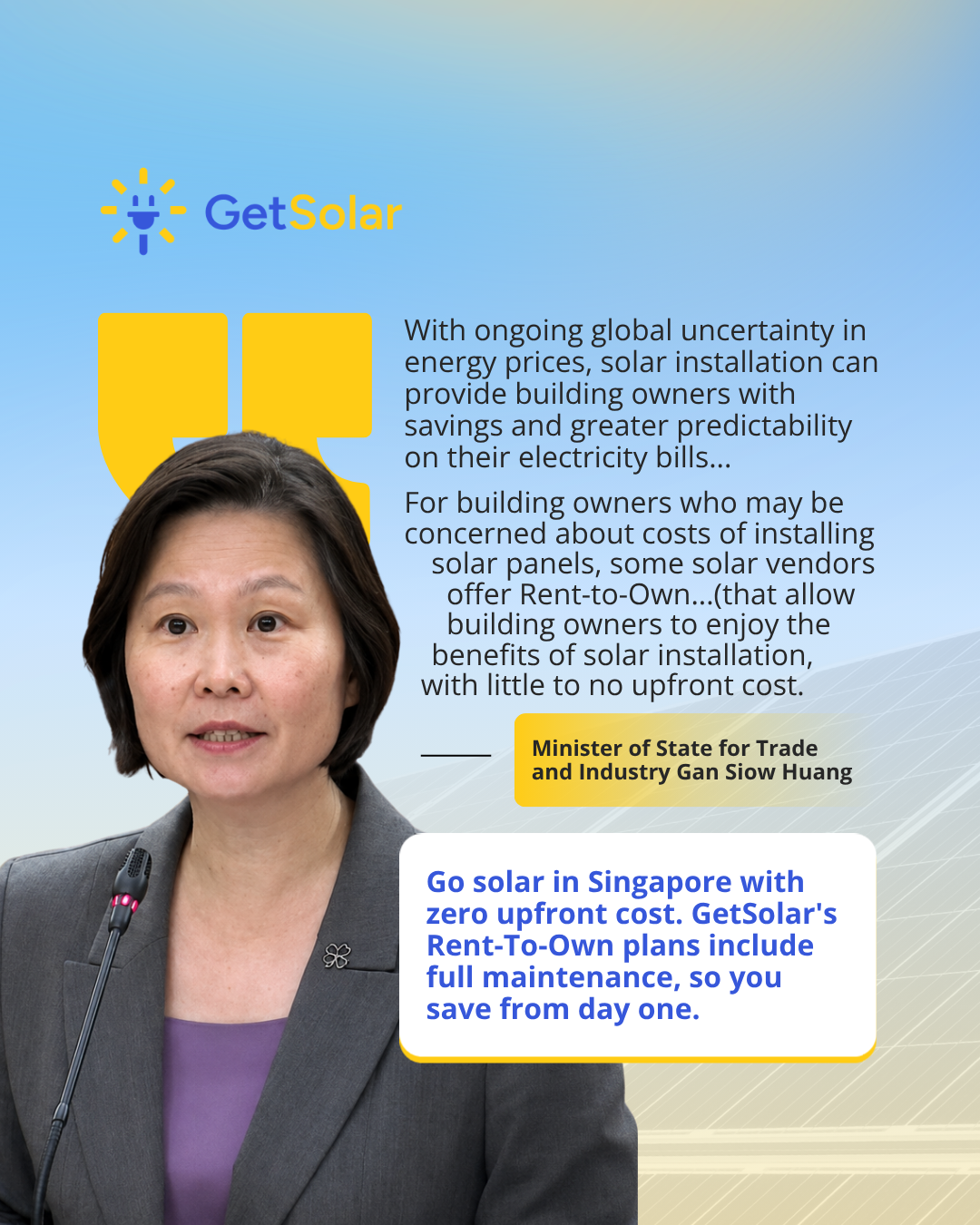
MOS Gan Siow Huang confirmed in Parliament on 7 May 2026 that local solar vendors are reporting increased interest from building owners as electricity tariffs rise. She cited savings, greater price predictability, and energy resilience as the three key benefits driving adoption, and pointed Rent-to-Own and leasing models as the reason more building owners are now signing up with little to no upfront cost.
When your electricity bill is sitting at around 30 cents per kWh and most forecasters expect it to stay elevated, more Singapore building owners are quietly asking the same question: is it finally time to go solar?
On 7 May 2026, that shift got a parliamentary mention. Minister of State for Trade and Industry, Gan Siow Huang, confirmed that local solar vendors have reported a notable increase in interest from building owners in recent weeks. She cited rising electricity tariffs, and many building owners anticipating further hikes ahead, as the main driver.
Three Benefits Named in Parliament
Gan was responding to parliamentary questions on residential solar adoption. Her reply set out three solar makes sense in the current environment:
- Savings: Solar offsets electricity that would otherwise be drawn from the grid at the prevailing SP Group tariff. Around 30 cents/kWh in 2026, every unit your panels generate is a unit you don't pay for.
- Greater predictability: Once installed, a solar system delivers a stable cost per kWh for the life of the panels, insulting you from from the quarterly tariff swings that have caught many households off guard.
- Energy resilience: Wider rooftop solar adoption reduces Singapore's dependence on imported natural gas, which currently accounts for the majority of the country's electricity generation.
Rent-to-Own and Leasing Models Are Removing the Main Barrier
The most common reason building owners have held back isn't scepticism, it's upfront cost. Gan addressed this directly, pointing to Rent-to-Own and solar leasing plans as a key reason more building owners are now signing up.
The model requires little to no upfront payment. You pay a fixed monthly fee, the provider handles installation and maintenance, and the system transfers to you at the end of the plan. The parliamentary reply did not name specific vendors, but the structure has become standard across the industry.
The Government's Position Is Clear
Solar adoption is accelerating on its own, driven by tariff economics and the spread of low-barrier financing. The government has no plans to mandate solar on new buildings, some rooftops simply aren't suitable but it will continue encouraging adoption and consider further measures if needed to push toward Singapore's 3 GWp solar target by 2030 (gigawatt-peak, a measure of total installed solar capacity).
Gan's three named benefits: savings, predictability, and energy resilience are now the clearest case for solar that Parliament has put on record.
If the tariff conversation has you thinking about your own roof, the startign point is straightforward. Use our free solar calculator to estimate your potential savings, or chat with our solar advisors for a no-obligation assessment.

Rent-to-Own Solar for Business with Guaranteed Performance
Immediate ROI



Rent-to-Own Solar. $0 Upfront cost. Guaranteed Savings
(10-Year RTO plan)
+ 10-Year Free Maintenance

Be part of The Solar Collective, where we share the latest updates, tips, and discussions on solar energy.