
Key Takeaways:
Solar in Singapore reduces real, measurable carbon emissions — a 400 kWp commercial system avoids around 240 tonnes of CO₂ per year by displacing natural gas-fired grid electricity. The numbers are estimates, not real-time measurements, and solar doesn't erase your full carbon footprint. Manufacturing the panels carries its own carbon cost, typically paid back through clean generation within one to three years.
Open any solar proposal in Singapore and you'll see the same two claims: "20 tonnes of CO₂ avoided per month" and "equivalent to 28 trees planted." If your first instinct is to wonder whether any of it holds up, that's a fair question.
Here's how these numbers are actually calculated, what they really mean, and where solar's carbon story gets oversold.
Singapore’s Energy Mix
Most of Singapore’s electricity comes from natural gas. While cleaner than coal, every unit of electricity consumed still produces carbon emissions.
With solar panels installed on your roof, you are generating electricity on-site, directly reducing the need to draw power from the grid.

How We Calculate Your Carbon Reduction
For every solar system, we work out two numbers:
- How much electricity your system will generate
- How much grid electricity it replaces
We then apply Singapore's grid emissions factor, published by the Energy Market Authority (EMA), to convert that displaced grid electricity into tonnes of CO₂ avoided.
One thing to be upfront about: these are estimates based on standard assumptions, not real-time measurements from your roof.
GetSolar’s Projects and Our Carbon Reductions
Here's what carbon reduction looks like across four of our live commercial installations in Singapore. System size is measured in kilowatt-peak (kWp), the maximum output capacity of a solar system under ideal conditions.
Sources: GetSolar internal project data
Why We Use "Trees Planted" as a Comparison
Carbon numbers in tonnes are abstract to most people. So we sometimes translate avoided emissions into a rough "trees planted" unit of measurement.
The two work differently, though:
- Trees absorb carbon gradually, over decades of growth.
- Solar avoids emissions immediately, by displacing fossil fuel electricity the moment it generates.
Same outcome on paper but different mechanism in practice. We use the tree comparison because it's relatable, not because a solar panel and a tree are interchangeable.
What Solar Does (And Doesn't Do)
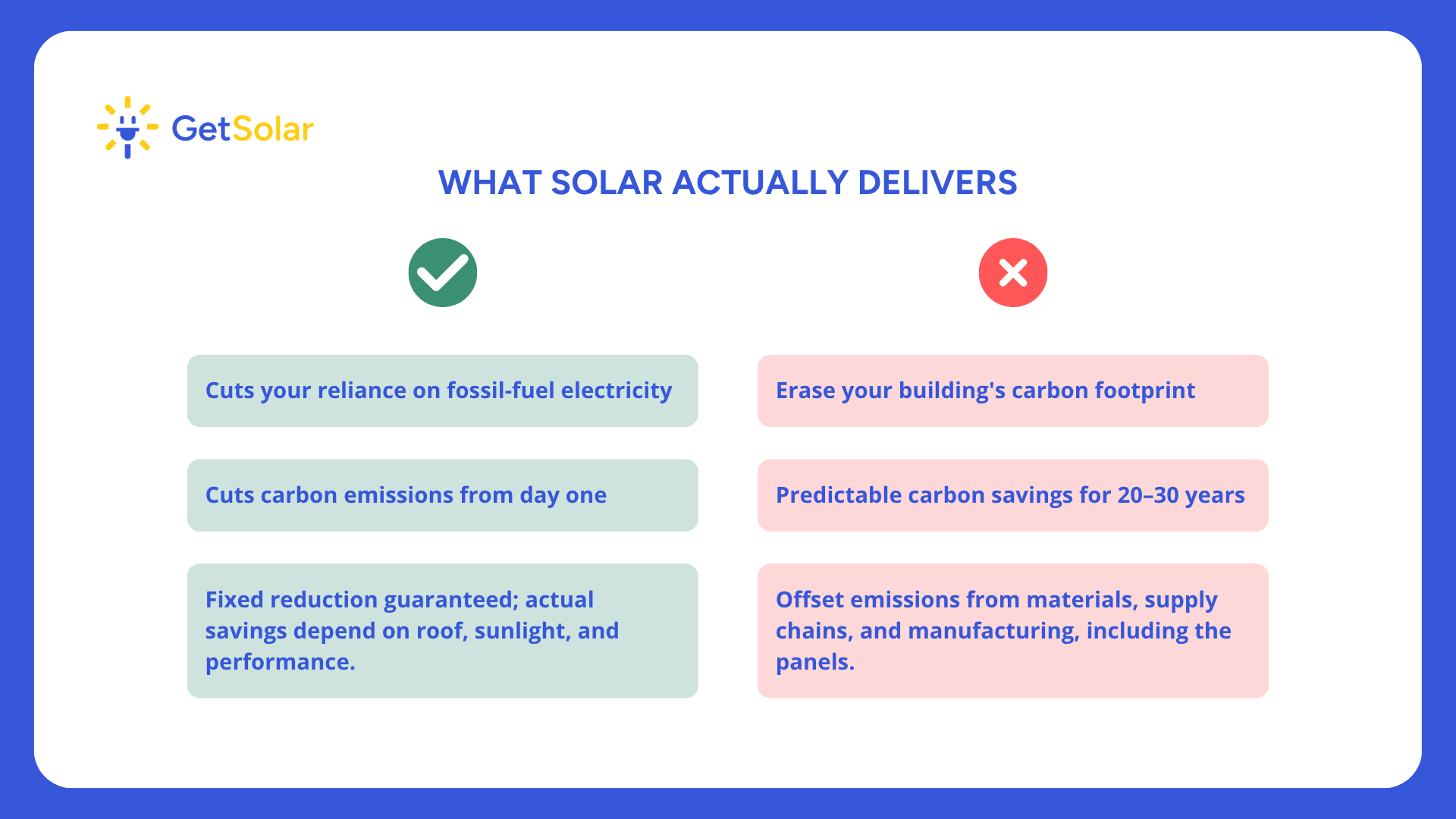
What solar does:
- Cuts your reliance on fossil-fuel electricity
- Reduces operational carbon emissions the moment it's switched on
- Delivers predictable carbon savings for the next 20-30 years
What solar doesn't do:
- Complete erase your building's carbon footprint
- Offset the emissions baked into construction materials, supply chains, and equipment manufacturing, including the panels themselves
- Guarantees a fixed reduction. Actual savings depend on your roof space, daylight hours, and how the system performs over time
Note: Manufacturing solar panels has its own carbon cost. Most systems pay that back through clean generation within one to three years, then keep avoiding emissions for the next two decades.
Why Monthly Carbon Tracking Matters
Annual figures don’t paint the full picture. We advise businesses to look at monthly avoided emissions instead, for three reasons:
- Operational accuracy: Monthly data reflects how the system actually performs across Singapore's rainy and dry periods.
- Target tracking: Quarterly sustainability reviews need monthly granularity to flag underperformance early.
- Reporting credibility: Auditors and ESG frameworks favour data that ties to an actual billing cycle, not a year-end estimate that's particularly under SGX's mandatory climate reporting requirements.
Not Perfect. But Real.
Solar has its limits. It won't entirely zero out your building's carbon footprint, and the carbon reduction figures in your proposal are usually modelled estimates, typically conservative against actual long-term output.
But if you're looking for something that works today in space-constrained Singapore, cuts real emissions from day one, and is straightforward to measure — solar is one of the strongest options on the table.
For a deeper look at how commercial solar performs across Singapore's building types, see our complete guide to solar for business in Singapore.
Curious what carbon reduction actually looks like for your building? Use our free solar calculator for an instant estimate of your system size, savings, and CO₂ avoided or chat with our solar advisors on WhatsApp for a no-obligation assessment.
No sales pitch. Just numbers you can sanity-check yourself.

Rent-to-Own Solar for Business with Guaranteed Performance
Immediate ROI



Rent-to-Own Solar. $0 Upfront cost. Guaranteed Savings
(10-Year RTO plan)
+ 10-Year Free Maintenance

Be part of The Solar Collective, where we share the latest updates, tips, and discussions on solar energy.